Systems Intelligence
AI is trained to work for the world.
We make it work for you.
Your knowledge. Your systems. Your processes. Your way of working.
The core technology
Atlas
Evidence & engineering intelligence
Understand what matters.
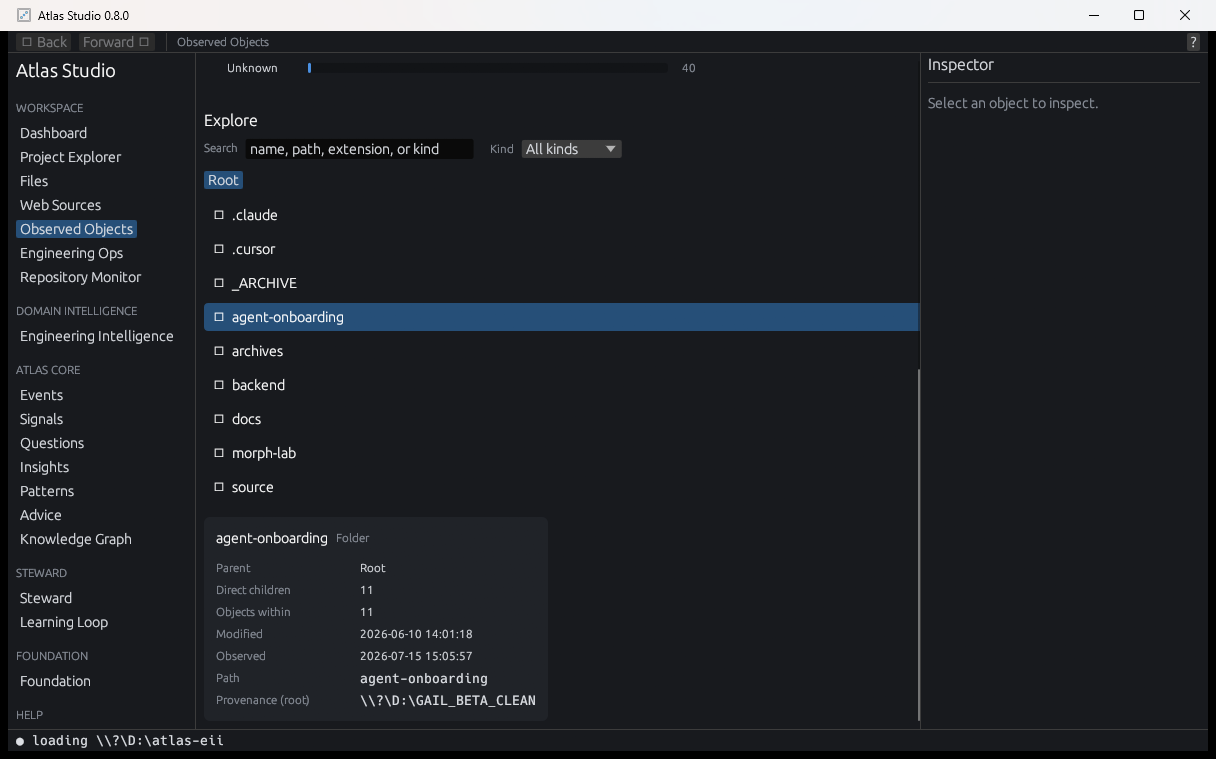
Atlas turns your own evidence and system history into measurable understanding. Every conclusion names what it rests on. Delete them all and Atlas rebuilds them from the record alone — identically, byte for byte.
And when the evidence will not carry an answer, it says so in writing rather than producing a plausible one. That refusal is part of the deliverable.
DEMONSTRATED COMMERCIAL
What it has actually done
Measured, not asserted.
Every figure below is a run that happened, on a real repository, with the output checked. None of it is a projection.
A real open-source repository ingested in full — 53,757 recorded facts, in 67 minutes, with no AI provider involved at any point.
Atlas observed the whole estate that produced it, including its own history. Commit, merge and author counts matched independent git accounting in every repository.
Matching SHA-256 hashes from two independently compiled binaries — code paths that never met, producing the same bytes.
Tests passing on the customer package, with a full dry run: coverage verified and double-run byte-identical regeneration both passing.
The defect record is published on the same terms. A fault that made 40% of one repository's file-level facts wrong was found, measured, fixed and written up — that record is why the rest of these earn belief.
Something you can actually try
Bolt a phone to a machine and it can see, hear, speak and be understood.
One install puts the handset's camera, microphone, speaker, screen, inertial sensor, GPS and light reading on your backend — and a readable face, an offline wake word and a personality on the front. Bought as parts, that is a wiring loom and a month of integration. It runs Kilo's head today, and it runs on an ordinary Android phone with no robot attached.
The rest of the portfolio
The method that produced it, and three proofs that it travels
Atlas is the thing that could become the company. These four are why anyone should believe it works.
The method that created it
AES — Make the work accountable.
The engineering discipline that keeps agent-assisted work reviewable — including a verdict most checklists omit: not run. Atlas was built under it, which is why its claims can be checked at all.
DEMONSTRATED
Explore the Engineering Lab →A human-facing application of the method
GAIL — Put intelligence to work.
A general-purpose agent that reaches the services you already use, remembers what happened, and may not tell you anything a tool did not actually return.
ACTIVE DEVELOPMENT
Explore GAIL →The method applied to an embodied machine
Kilo — Put intelligence in motion.
An embodied agent that sees, moves, communicates and remembers, under a safety-first motion authority every command must pass. Autonomous driving demonstrated — and its head is an Android app you can run yourself.
ACTIVE DEVELOPMENT
Explore Kilo →Proof it becomes something people buy
Garage Library — Keep what you learned.
Hard-won knowledge turned into thirteen finished, purchasable titles by a single engine. It has taken its first real customer sale — which is not a business, but is no longer zero.
DEMONSTRATED
Explore the Library →The honest part
What we need to prove next
Not a roadmap. These are the things that have not happened yet, in the order they need to. Every one is a test we could fail.
Someone outside Knowlton runs Atlas.
On a repository we did not write.
Atlas tells them something useful they did not already know.
The actual product test.
Someone wants to run it again.
Unprompted.
Someone pays for the result.
Atlas has no customer yet.
Someone other than its author can operate the system.
Today the operator is a single point of failure.
A company principle
Your data is yours.
Knowlton builds systems that work with your information without making your information the product.
We don't want your data. That is an architectural decision before it is a policy one, and it shows up differently in each system: Atlas runs where the evidence already lives, so a repository never has to be handed over. GAIL is designed to reach into the services you already use rather than copy them into a store of ours. Kilo's head recognizes people entirely on the device, and asks before it remembers anyone at all.
Stated as design intent and current implementation, not as a certification. The security page sets out exactly what is and is not claimed.
The mission
What the work is for
Guys in the Garage is the nonprofit mission organization. Knowlton Industries is the technology and commercial identity.
Knowlton develops commercial technology and products intended to create sustainable economic support for Guys in the Garage and its mission.