Atlas · How it works
Evidence before conclusion.
Atlas records what happened, measures it, and derives answers that name the evidence behind them. Delete every answer and it rebuilds them from the record alone — byte for byte. This page is the mechanism; the system page is the argument.
The mechanism
Observe, record, measure, ask, answer
- 1 — ObserveAtlas reads a repository locally and interprets its history, turning it into typed facts: a commit was detected, a file was added, a branch moved, a merge happened.
- 2 — Record before reactingEvery fact is written to an append-only log and flushed to disk before anything downstream sees it. That log is the only thing Atlas treats as authoritative.
- 3 — MeasureRules read the log and emit signals. A signal states what is — a number, a unit, a description — and carries the events it was computed from and a stated confidence. It carries no interpretation.
- 4 — AskA question declares what kind of evidence it needs, never which rule or which signal, and is checked for readiness before anything is attempted: answerable, insufficient evidence, or structurally unobtainable.
- 5 — Answer, or declineAnswerable questions produce a written answer naming every source event and the rule that measured it. The rest are printed under not established, with the reason, in the same document.
Determinism
Two binaries. One set of hashes.
Determinism is easy to claim and hard to prove. The proof here is the strongest kind available: two separately compiled products, with different entry points and different command surfaces, analyzing the same repository and producing files whose cryptographic hashes match exactly.
Fourteen SHA-256 values. Seven identical pairs, produced by code paths that never met.
| Derived object | First binary | Second binary | |
|---|---|---|---|
| does-history-reach-origin | 4a249fd44ec18c2feb0ed745863266f864e26204557336adbecf09ae9087a919 | 4a249fd44ec18c2feb0ed745863266f864e26204557336adbecf09ae9087a919 | match |
| is-development-active-at-window-end | 2c96fc4c489cdbd90e825ef5003678a7f44f272edeb500dce41a07357fc3da88 | 2c96fc4c489cdbd90e825ef5003678a7f44f272edeb500dce41a07357fc3da88 | match |
| what-is-the-observed-activity | 5c3348cb93410911ed3bf74215e324cc76766ca7c12d61ba652f62b0ece1b242 | 5c3348cb93410911ed3bf74215e324cc76766ca7c12d61ba652f62b0ece1b242 | match |
| where-does-change-concentrate | 4d07c0217d40a31d05e4ed1d8c862fecbfaef2b421b3490302662f9e5bbadaba | 4d07c0217d40a31d05e4ed1d8c862fecbfaef2b421b3490302662f9e5bbadaba | match |
| input bundle | eade033e2bb98b84…9381 | eade033e2bb98b84…9381 | match |
| the two recommendations | — differ — | — differ — | differ by embedded timestamp |
Two files did not match — the two recommendations, because each embeds the time it was generated. That is stated plainly, because a determinism claim that hides its exceptions is not a determinism claim.
This is not a property that survives casual engineering. It required removing the system clock from every derivation path, deriving freshness from the evidence window rather than the current date, and sorting every provenance list before writing it. Each is a small discipline; together they are why the hashes match, and why retrofitting this into an existing system is expensive.
The application
The instrument must not lie
Atlas ships as a desktop application whose sections are Dashboard, Questions, Insights, Patterns, Event Log and provenance, Learning Loop, Steward, and Engineering Intelligence. One binding rule governs all of them: no reasoning happens in the interface, and absence is shown with a reason rather than as a blank.
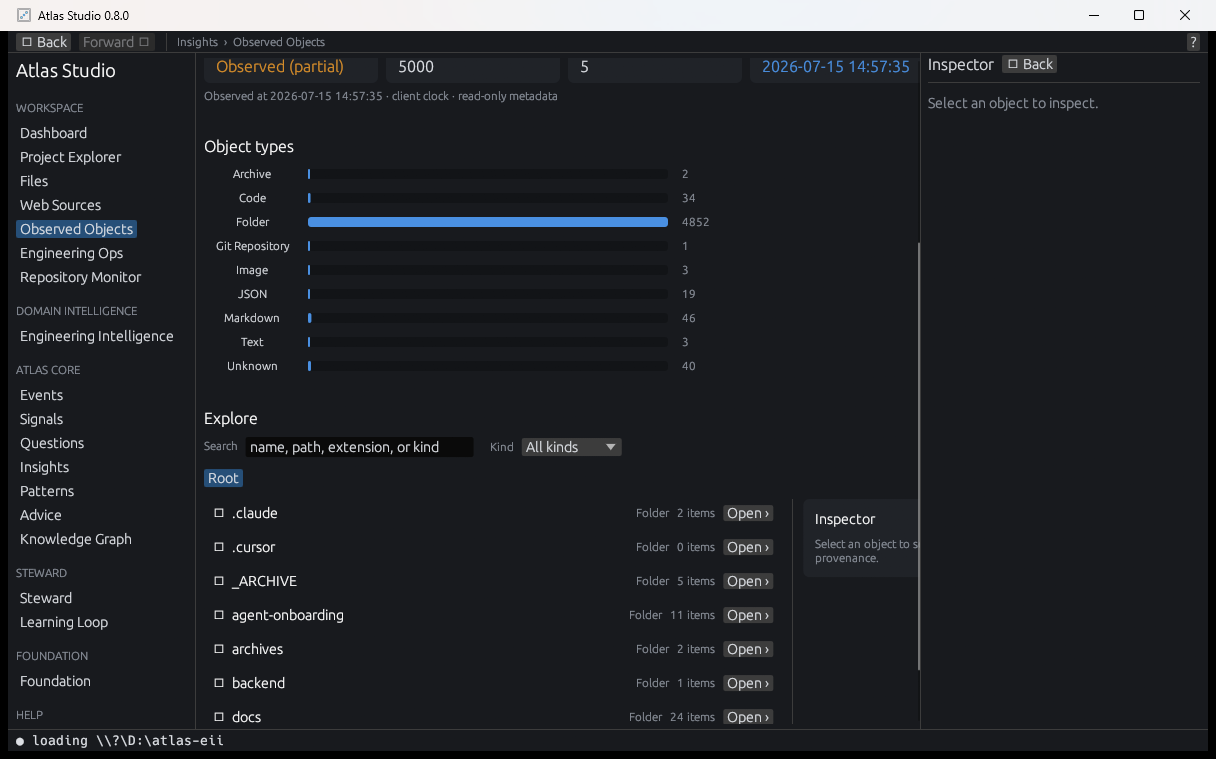
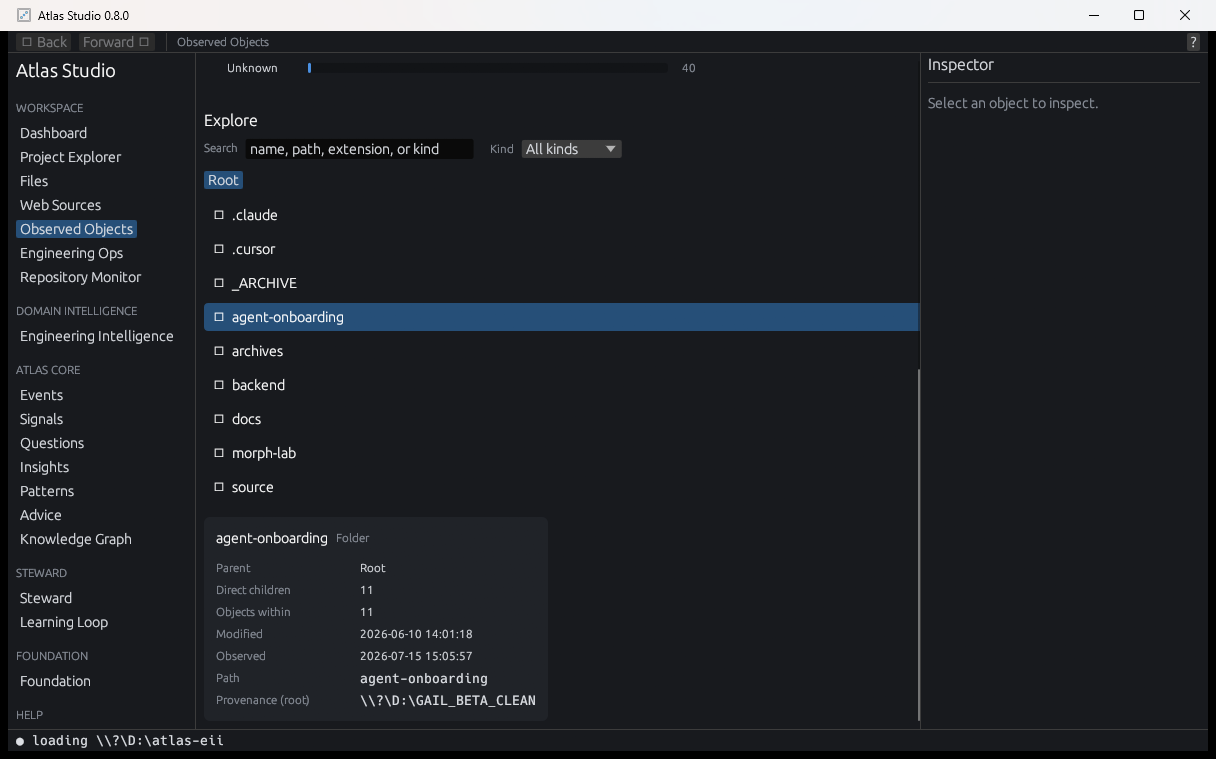
Captures from an earlier build of the application. Current captures replace these when they are taken.
Limits
What Atlas does not do
- It does not read your code. Atlas reads history and metadata — who changed what, when, and how often. It does not parse source, evaluate dependencies, check licenses or look for vulnerabilities.
- It does not predict. Every statement is about observed history. Nothing is forecast or extrapolated.
- It analyzes one repository at a time. There is no cross-repository view. The largest single run recorded is 4,349 commits, in 67 minutes.
- No AI feature has ever returned a live answer. Atlas has a designed connection point for language models. It works against a test stub and has never run successfully against a live provider. Atlas runs entirely without it — which is why the failure was silence rather than invention.
- Extending it means writing code. Questions and rules are authored as data-shaped definitions, which is what allowed a whole second domain to be added without touching the engine — but they are compiled in. There is no plugin format.
- There are no customers yet. No third party has run Atlas, reviewed it, or bought anything.