Systems · Evidence Intelligence
Answers you can regenerate.
Understand what matters. Atlas turns your evidence and system history into measurable understanding — with provenance on every conclusion, and a documented refusal when the evidence will not carry one.
What it is
Evidence before conclusion.
Ask a general-purpose AI about your codebase and it answers from the world's information — how software is usually built, what a project like yours normally looks like. It has never seen yours.
Technical understanding assembled that way is the same as the alternatives it replaces: someone's memory of the codebase, a deck, a summary nobody can audit. All of them degrade silently, and none can be checked.
Atlas replaces that with observation. It records what actually happened as durable evidence, measures it, and derives conclusions that name the evidence they came from. Delete every conclusion and Atlas rebuilds them from the record alone — identically, byte for byte.
Atlas does not make a guess just because a question was asked.
When the evidence cannot support an answer, Atlas produces a different kind of output: what was asked, what was missing, and whether the gap is fillable or structurally impossible. That refusal is part of the deliverable, not an error.
What it does
Four properties worth the trouble
It regenerates
Run it twice over the same record and you get the same bytes — not similar output, identical output. Verified across two independently compiled binaries producing files with matching SHA-256 hashes.
DEMONSTRATED
It carries provenance
Every derived conclusion names the events it rests on, the rule that produced it, and a stated confidence. Nothing on the screen is unattributable.
DEMONSTRATED
It refuses
A question the evidence cannot answer is printed as not established, with the reason, in the same document as the answers. A test exists specifically to assert this.
DEMONSTRATED
It needs no AI provider
Atlas runs with none configured, and that is the shipped default. It does not need a model to work, and it does not simulate one when none is present.
DEMONSTRATED
A company principle
Run Atlas where the evidence lives.
Atlas analyzes on the machine that already holds the material. No repository has to be handed over, no history has to be uploaded, and nothing has to leave the environment it came from to be understood.
Stated as design intent and current implementation, not as a certification. The security page sets out exactly what is and is not claimed.
Proof
What it has actually done
It read its own estate
Atlas observed the whole 22-repository estate that produced it, including its own history. Commit, merge and author counts matched independent git accounting in all 22.
It ran at commercial scale
A real 4,349-commit open-source repository ingested in full — 53,757 recorded facts, coverage exact, two full passes byte-identical.
The questions change the outlook
One record, two different question sets, no engine change — and materially different conclusions from identical bytes. What you ask is the analysis.
It publishes its own defects
A defect that made 40% of one repository's file-level facts wrong was found, measured, fixed and written down. That record is how the rest of the claims earn belief.
The application
An instrument, not a dashboard
The desktop application's sections are Dashboard, Questions, Insights, Patterns, Event Log and provenance, Learning Loop, Steward, and Engineering Intelligence. Its binding rule is that the instrument must not lie: absence is shown with a reason rather than as a blank.
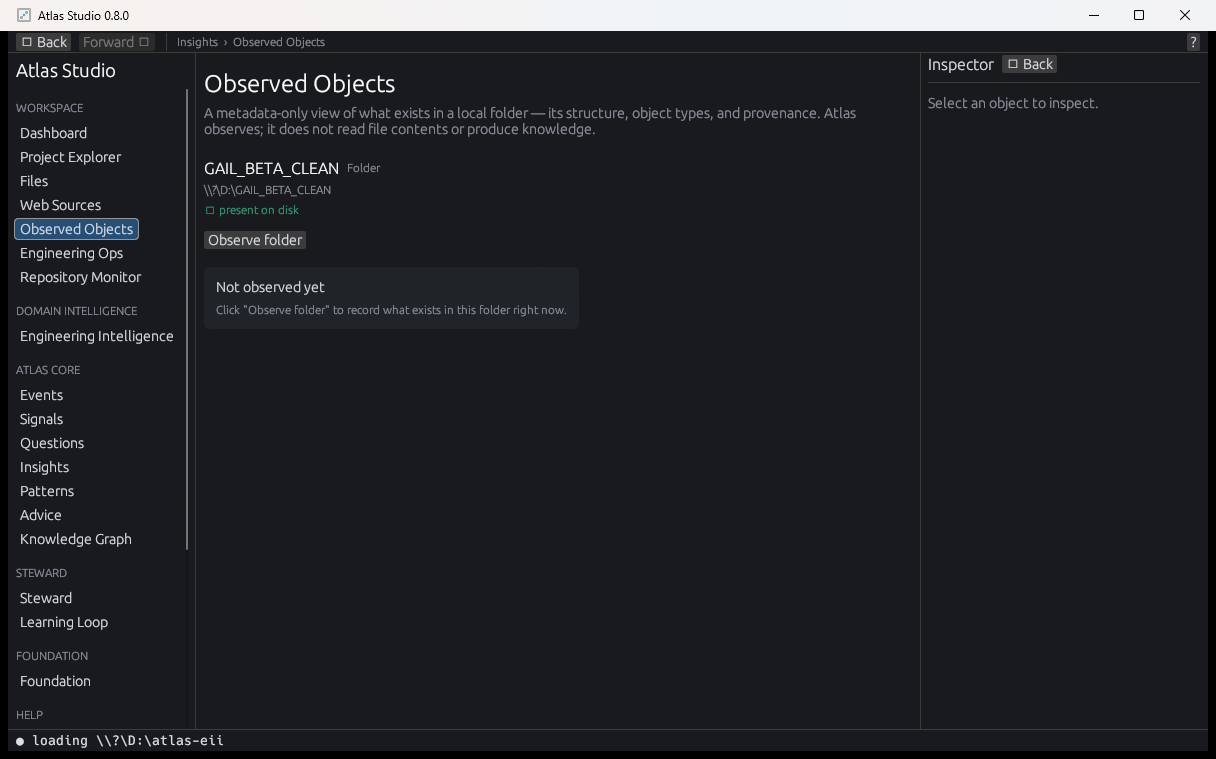
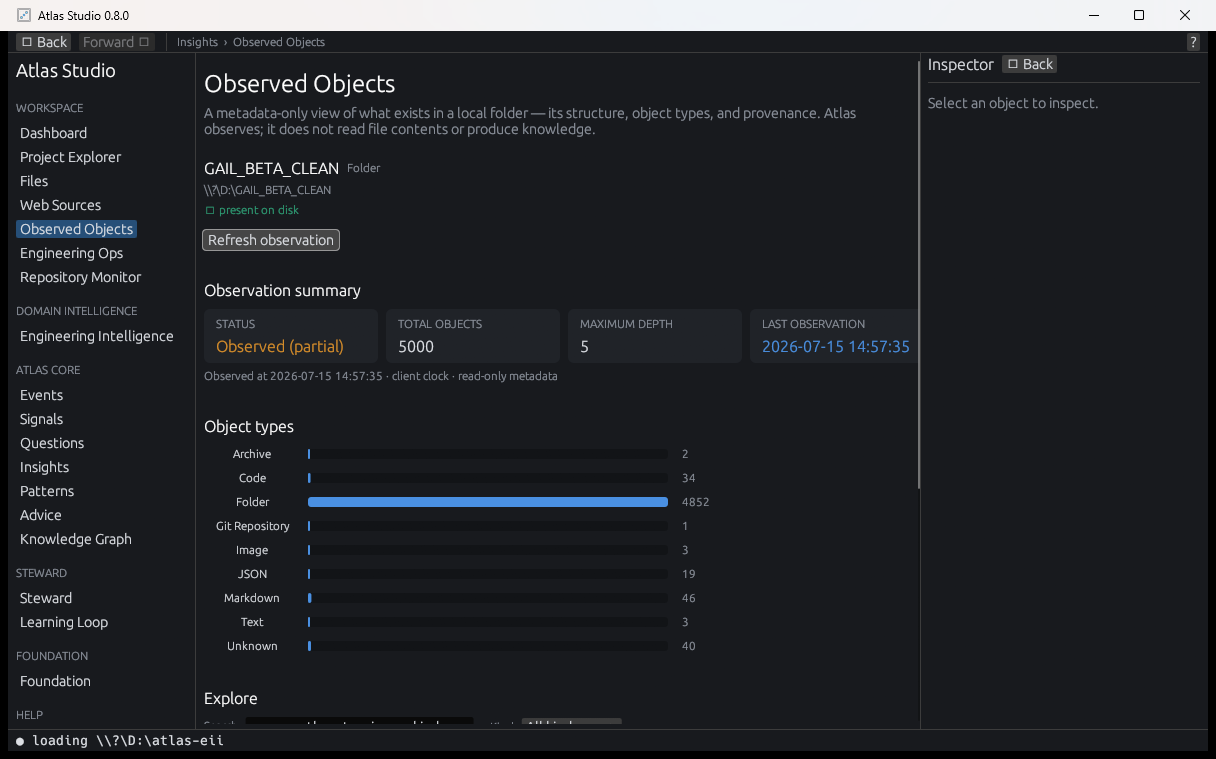
Captures from an earlier build of the application. Current captures replace these when they are taken.
What it can become
More lenses, not a bigger engine
The engine is deliberately frozen. Growth happens in lenses — declarative packs, loaded outside the core, that decide what questions get asked of a body of evidence. Adding a whole new domain has already been done without touching the engine, which is what makes the next one cheap.
The first commercial lens is acquisition diligence: the Atlas Acquisition Evidence Screen, which establishes what a target's engineering evidence actually supports before expensive technical diligence begins. Engineering intelligence, reconstruction and document evidence are the named candidates behind it.
Atlas has no external users yet. Nothing here is claimed as production-verified, and no sale is claimed.
Why it matters
The thesis, in its most literal form
AI can generate an analysis of anything in seconds. The value of an analysis is not that it exists — it is whether you can check it. Atlas is the system that makes a conclusion checkable: where it came from, what it rests on, and what could not be established at all.
The engine model, the determinism proof and the full limits are set out on how Atlas works. The complete technical record is available in partner diligence.